The Role of Surveys and Valuations in the Mortgage Process
Understand the key differences between mortgage valuations and surveys. Learn about the types of surveys, costs, benefits of using RICS surveyors, and factors considered during valuations.
08/04/2025By Pauzible Team · Editorial Team
Introduction
Obtaining a mortgage involves several key steps, including conducting property surveys and valuations. These assessments are crucial as they inform both the lender and the buyer about the property's condition and market value.
Mortgage Valuation:
A mortgage valuation is conducted primarily for the lender's benefit. Its primary purpose is to ensure that the loan amount will meet the lender’s loan-to-value criteria (assuming that all other criteria, including affordability, will also be met by the prospective borrower).
A mortgage valuation, thus, focuses primarily on assessing if the property provides adequate security for the loan to the lender. It is not an exhaustive inspection but checks the property's basic condition, price and marketability.
Typically concise, it does not delve into in-depth issues or potential future repairs. The surveyor might not look beyond easily observable issues and will not move furniture, lift carpets or inspect concealed spaces.
The mortgage valuation is used by the lender to make a decision about loan approval, and the loan amount and terms. It does not provide the buyer with any guarantee about the property's condition.
Mortgage Survey:
A mortgage survey, by contrast, is more comprehensive and is primarily conducted for the buyer's benefit. This type of survey helps identify potential issues with the property, providing a deeper level of insight. Types of RICS (Royal Institution of Chartered Surveyors) mortgage survey include:
- Condition Report: This most basic level of a RICS mortgage survey is suitable for new properties in good condition, highlighting any defects that require immediate attention.
- Homebuyer Report: More detailed than a Condition Report, this type of RICS survey is suitable for properties in reasonable condition. It includes all the features of a RICS Condition Report, and adds market valuation and rebuilding costs (from a buildings insurance perspective). This survey also checks for issues such as dampness and the condition of the visible parts of a building.
- Building Survey: This is the most comprehensive type of survey and is usually associated with older properties or those needing repair. It analyses the property's condition in-depth, including primary and minor defects, repair options and maintenance advice.
Choosing the Right Survey:
The choice of survey depends on several factors, including the property's age, condition and the buyer's plans:
- For New Builds: A RICS Condition Report might suffice, given the lower risk of extensive repairs.
- For Standard Transactions: A RICS Homebuyer Report often provides the right balance of insight and cost, making it suitable for most properties in relatively good condition.
- For Properties that are Older or in Need of Repair: A RICS Building Survey is advisable due to the higher risk of structural issues or hidden defects.
Understanding these distinctions helps buyers make informed decisions about the level of risk that they are prepared to accept and the amount they are willing to spend on surveying a property.
Valuation Fundamentals
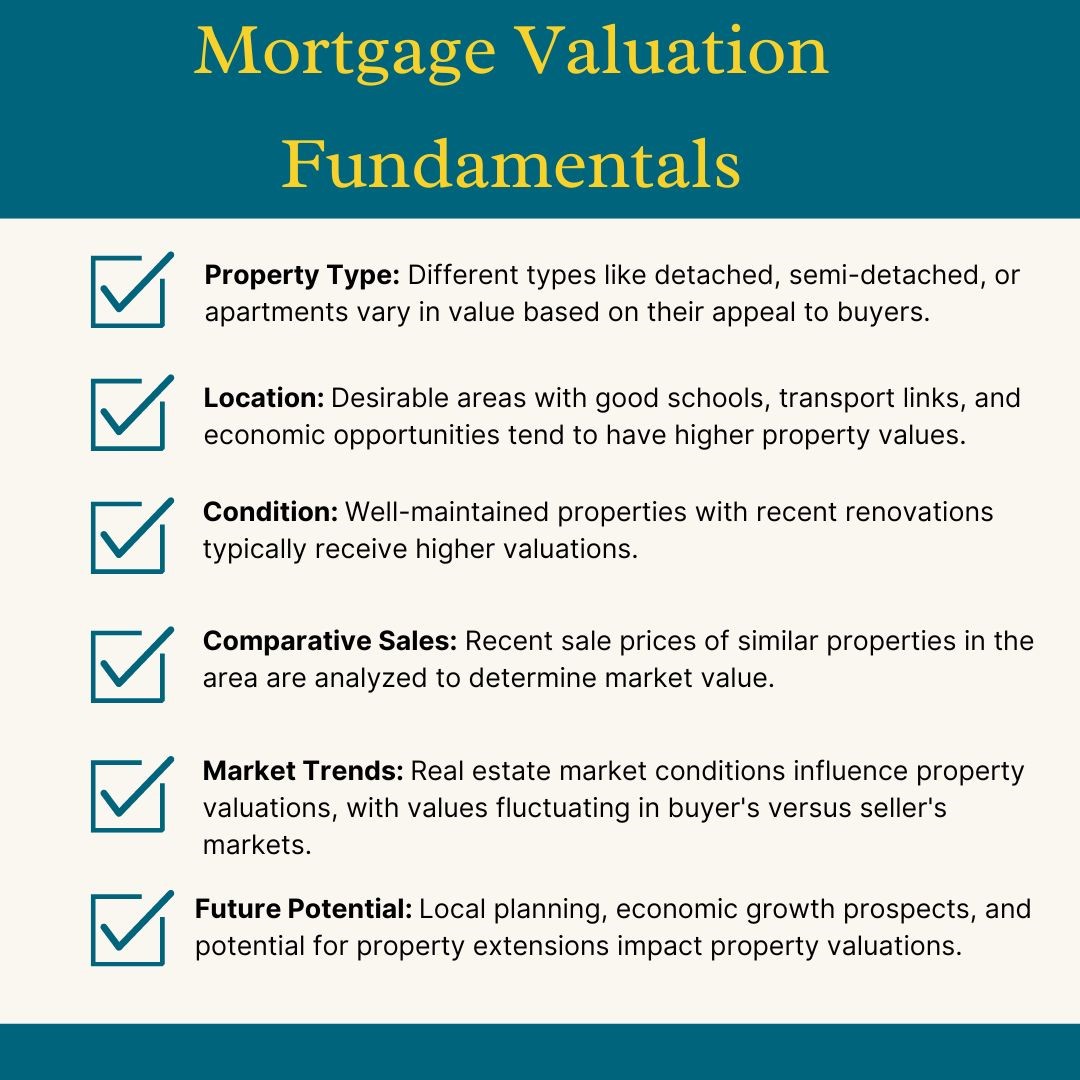
During a mortgage valuation, several factors are considered to determine the property's market value, with a view to ensuring that the loan amount granted by the lender is appropriate and secure. This valuation is crucial as it influences both the lender's decision to provide financing and the terms of the mortgage itself. Some key factors considered during a mortgage valuation include:
1. Property Type: The kind of property being assessed—whether it is a detached, semi-detached or terraced house; bungalow; apartment and so on—plays a role in its valuation. Different property types in the same area may have different market values due to their varying appeal to potential buyers.
2. Location: This is an important factors in property valuation. Properties in desirable locations, such as those in good school districts, near public transport or in major economic hubs, for example, typically hold higher values. Conversely, properties in less desirable areas might be valued lower, even if the houses are similar.
3. Condition: The current state of the property can affect its valuation. A well-maintained property with recent renovations, such as a new roof, windows, kitchen or bathrooms, is generally likely to receive a higher valuation compared to one that requires significant repairs.
4. Comparative Recent Sales Data: Valuers extensively analyse the sale prices of similar properties recently sold in the same or nearby areas. This comparative analysis helps ensure that the valuation is market-aligned. If similar properties in the vicinity have sold for significantly higher or lower prices, this will impact the valuation given to the property in question.
5. Market Trends: The overall health of the real estate market also influences valuations. Property values might be lower during a buyer's market due to higher inventory and less competition among buyers. Conversely, in a seller’s market, property values can be higher.
6. Future Potential: Factors such as local planning policies, the future economic growth potential of an area or potential for extending a property can also affect its valuation. For instance, a property with space for expansion or a property located in an area where values are expected to rise due to major upcoming investment might be valued more highly.
Online Valuation Considerations
While online property valuations offer a quick estimate, they might be based on outdated or generalized data. Traditional valuations are generally better for a more reliable assessment. Investing in a detailed survey and valuation mitigates risks, protects investments and supports informed decision-making throughout the mortgage process. Understanding the property's actual condition and value can also potentially save future costs and complications.
Understanding Costs and Benefits of Mortgage Surveys and Valuations
1. Average Costs of Mortgage Surveys
The cost of obtaining a RICS mortgage survey can vary widely depending on the type and depth of the survey chosen:
Condition Report (Level 1 Home Survey):
Cost: Typically ranges between £300 to £900. The price varies depending on the property's location and market value.
Description: This is the most basic survey offered and is suitable for new-build and conventional homes in good condition. It summarizes the property's condition and highlights significant visible defects but does not include advice or a valuation.
Homebuyer Survey (Level 2 Home Survey):
Cost: Generally varies from £400 to £1000. This survey is more detailed and thus costs more than the essential Condition Report.
Description: This survey is suitable for conventional properties in reasonable condition. It provides more extensive information on the property's condition, including advice on repairs and ongoing maintenance needs. This survey type is popular due to its detailed nature and practical advice.
Building Survey (Level 3 Home Survey):
Cost: Prices range from about £630 to £1,500 and upwards, depending on the property's size and condition.
Description: Also known as a structural survey, this is the most comprehensive survey. It is usually used for older homes, those needing repairs or if you are planning major renovations. It provides detailed advice on the property's condition, including defects and necessary repairs.
2. Mortgage Valuation vs. Full Structural Survey
A mortgage valuation assesses a property's market value for the lender but is relatively light touch. By contrast, a complete structural survey is thorough, examining all accessible parts of the property and detailing potential repair needs and costs. Factors such as structural integrity, presence of hazardous materials like asbestos, and the condition of roofs and foundations are also checked in complete surveys, although not in basic valuations.
3. Benefits of Using a RICS-Accredited Surveyor
Employing a RICS-accredited surveyor ensures that the survey is conducted according to high professional standards. RICS surveyors adhere to a strict code of conduct, which includes maintaining objectivity, providing a high level of detail in reports and carrying professional indemnity insurance. This accreditation assures homeowners and buyers about the survey's accuracy and reliability.
FAQs:
Q. What is the difference between a mortgage survey and a valuation?
A: A mortgage valuation is conducted primarily for the lender's benefit. Its primary purpose is to ensure that the loan amount will meet the lender’s loan-to-value criteria (assuming that all other criteria, including affordability, will also be met by the prospective borrower). A mortgage survey, on the other hand, is more comprehensive and is primarily conducted for the buyer's benefit. This type of survey helps identify potential issues with the property.
Q. Do I always need a survey when getting a mortgage?
A: It is not mandatory to have a survey done when obtaining a mortgage, but is recommended to ensure that there are potentially no issues with the property that could give rise to future costs or valuation concerns.
Q. What are the different types of mortgage survey available and which one should I choose?
A: The main types of RICS (Royal Institution of Chartered Surveyors) survey are the Condition Report, Home Buyer Report and Building Survey. The choice depends on the property's age, condition and specific concerns; the more detailed the survey, the more information you will get about the property and the need for any repairs.
Q. What factors are considered during a mortgage valuation?
A: Factors considered during a mortgage valuation include the property type, its location, condition and current market trends.
Q. Can I negotiate the sale price based on the mortgage valuation?
A: If the mortgage valuation comes in lower than the asking price, it can potentially be used as leverage to negotiate a lower sale price with the seller.
Q. Are online mortgage valuations reliable alternatives to traditional valuations?
A: Online valuations may lack the depth of traditional valuations that include physical inspections. They may be useful for a quick preliminary assessment, but are generally not a substitute for a physical mortgage valuation or survey.
The Pauzible Team consists of finance professionals and property market specialists dedicated to reinventing home ownership and BTL financing. With deep expertise across UK real estate and innovative financial products like Equity Partnership Agreements, we provide landlords and homeowners with the insights they need to unlock equity, navigate market volatility, and build sustainable wealth through property. Our mission is to make complex property finance simpler, quicker, and more accessible for everyone.
Ready to see what Pauzible could unlock?
Explore how accessing equity from your BTL property could support your business investment plans.
No obligation. Just a clear view of what might be possible.